
Geometry: Exploring the World of Angles and Lines
Geometry is a fascinating branch of mathematics that deals with the properties and relationships of shapes, angles, and lines. This blog will take you on a journey to explore the fundamental concepts of geometry and how they apply to the world around us. From basic angle measurements to the intricate properties of polygons, we will delve into the wonders of geometry. Students can also reinforce these concepts through structured lessons on Khan Academy geometry resources.
1. Angle Basics
Understanding angles is crucial in geometry. Angles are formed by two rays or line segments that share a common endpoint called the vertex. In this section, we cover the different types of angles, such as acute, obtuse, and right angles, and explore their properties.
An acute angle is less than 90 degrees, an obtuse angle is greater than 90 degrees but less than 180 degrees, and a right angle measures exactly 90 degrees. We also discuss angle measurement techniques, including degrees and radians. Degrees are commonly used to measure angles, while radians are frequently used in advanced mathematics and physics.
Students can explore additional practice on angle relationships through Math is Fun angle lessons.
2. Lines and Line Segments
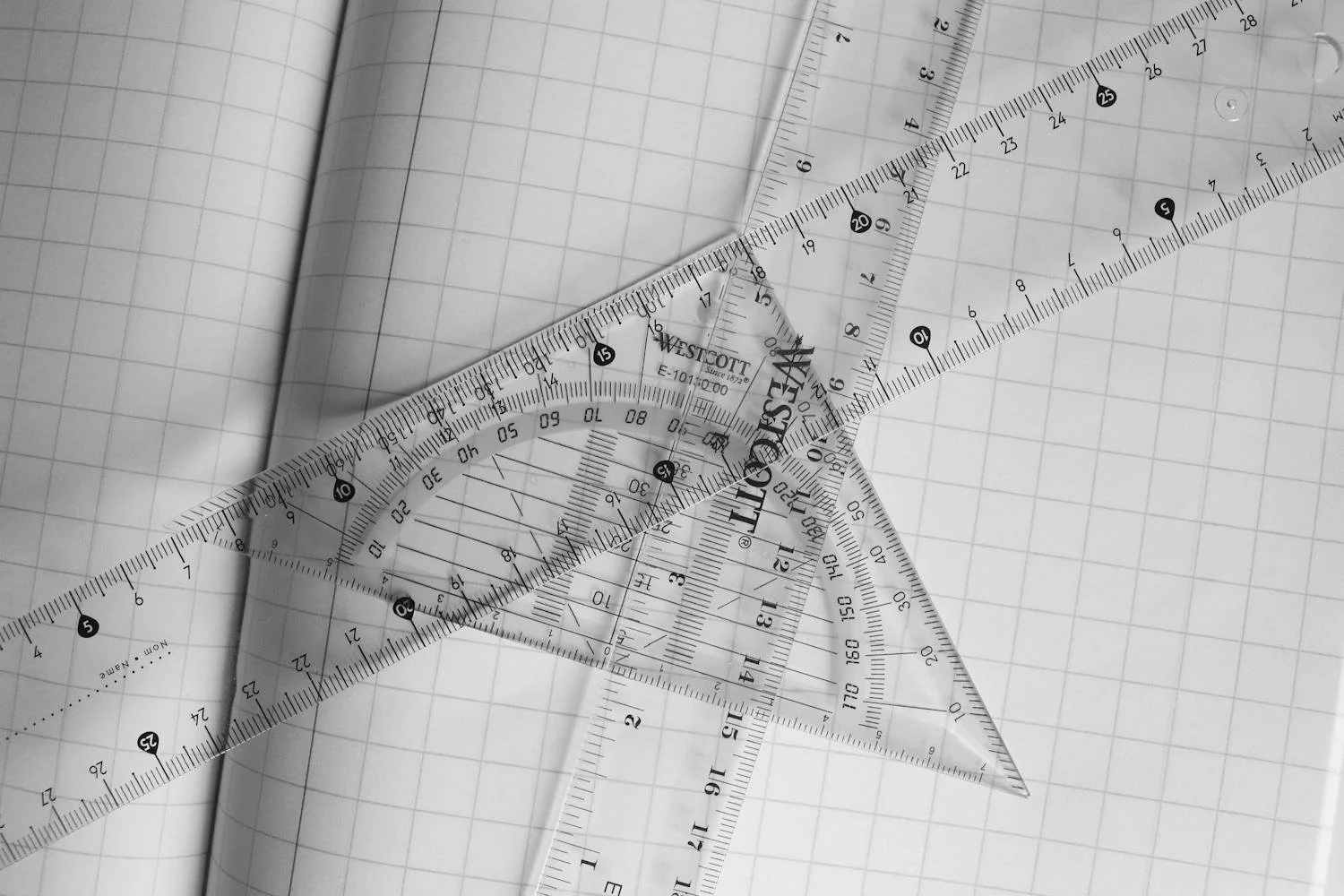
Lines and line segments are fundamental elements in geometry. A line extends infinitely in both directions, while a line segment has two endpoints. We explore the characteristics of lines, including their lengths and slopes.
The slope of a line represents its steepness and can be calculated by finding the ratio of the vertical change to the horizontal change between two points. Additionally, we examine parallel lines, which never intersect, and perpendicular lines, which intersect at right angles.
Transversals intersect parallel lines and create various angles, including corresponding angles and alternate interior angles. Students can deepen their understanding through analytic geometry lessons.
3. Polygons and Their Properties
Polygons are closed figures formed by straight lines. We begin with triangles and explore types such as equilateral, isosceles, and scalene triangles. Quadrilaterals include squares, rectangles, parallelograms, and trapezoids.
We also explore regular polygons, which have equal side lengths and equal angles. Understanding these properties helps students classify shapes and solve geometric problems. Additional polygon resources are available through polygon guides from Math is Fun.
4. Circles and Circular Geometry
Circles are intriguing geometric shapes with unique properties. The radius is the distance from the center to the edge, while the diameter passes through the center. The circumference represents the distance around the circle and is related to pi.
We also explore angles formed by chords, secants, and tangents. These relationships are essential in solving circle-related problems. Students can review these concepts through circle geometry lessons.
5. Geometric Transformations
Geometric transformations involve changing the position, size, or orientation of shapes. These include translation, reflection, rotation, and dilation.
Translations shift shapes, reflections flip them, rotations turn them, and dilations change size. Understanding these transformations allows students to analyze geometric figures in different positions. Students can explore transformation concepts further through geometry transformation lessons.
6. Key Geometry Concepts Overview
| Concept | Description | Example Use |
|---|---|---|
| Angles | Measure of rotation between lines | Finding unknown angles |
| Lines | Infinite straight paths | Graphing and slope |
| Polygons | Closed shapes with straight sides | Area and perimeter problems |
| Circles | Round shapes defined by radius | Arc and circumference calculations |
| Transformations | Changing shape position or size | Coordinate geometry |
7. How Stemly Tutoring Helps
Geometry is a captivating field that strengthens problem-solving and spatial reasoning skills. Stemly Tutoring offers specialized Geometry Tutoring to support students in mastering these concepts.
Our tutors provide:
Personalized instruction
Clear explanations of complex topics
Practice exercises and strategies
Strong foundational support
With the guidance of experienced tutors, students can excel in geometry and build confidence in math.

8. FAQs
Q1: Why is geometry important?
It develops logical thinking and spatial reasoning skills.
Q2: What is the hardest part of geometry?
Many students find proofs and transformations challenging.
Q3: How can I improve in geometry?
Practice regularly and focus on understanding concepts, not just memorizing.
Q4: Where can I practice geometry?
Students can use Khan Academy or guided tutoring sessions.
9. Next Steps
To succeed in geometry:
Review core concepts consistently
Practice solving different types of problems
Use visual aids to understand shapes
Focus on weak areas
Seek help when needed
Students can also explore structured learning through Khan Academy geometry resources to reinforce their understanding.
A strong foundation in geometry will support success in algebra, trigonometry, and calculus.
Ready to improve your geometry skills and build confidence? Book a consultation call with Stemly Tutoring today and get a personalized learning plan designed to help you succeed in geometry and beyond.