
Why STEM Needs More Hands-On Learning
- 1. Understanding the Value of Hands-On STEM Learning
- 2. Why Hands-On Learning Matters in STEM
- 3. Key Benefits of Experiential Learning
- 4. Comparison: Traditional vs. Hands-On Learning
- 5. How Schools Can Integrate Hands-On STEM Learning
- 6. Role of STEM Tutoring in Practical Learning
- 7. FAQs
- 8. Next Steps
1. Understanding the Value of Hands-On STEM Learning
STEM forms the backbone of innovation and progress. Yet, for many students, these subjects can feel abstract or intimidating when taught solely through textbooks and lectures.
Hands-on learning brings STEM to life. When students design, build, and experiment, they bridge the gap between theory and application. They begin to see how math connects to engineering, how science explains real-world phenomena, and how technology enables problem-solving.
Research consistently shows that students who learn by doing retain knowledge longer and develop stronger problem-solving and critical-thinking skills.
2. Why Hands-On Learning Matters in STEM
Traditional classroom instruction often prioritizes memorization and theory, which limits creativity and engagement. In contrast, hands-on learning allows students to experience how science and math operate in the real world.
It encourages curiosity, experimentation, and the freedom to fail — all essential components of scientific discovery. Students learn through trial and error, building resilience and adaptability that extend beyond academics.
Furthermore, hands-on learning addresses various learning styles. Kinesthetic learners, who grasp concepts better through movement and touch, thrive when given tools and real-world challenges.

3. Key Benefits of Experiential Learning
Hands-on STEM learning enhances education in several important ways:
Deeper Understanding: Students move beyond rote memorization to true conceptual comprehension.
Increased Engagement: Real-world challenges make STEM subjects more relatable and exciting.
Critical Thinking and Collaboration: Group projects simulate real engineering and scientific teamwork.
Creativity and Innovation: Designing solutions encourages creative problem-solving.
Career Readiness: Practical skills prepare students for technical fields and future STEM careers.
This approach transforms passive learning into active exploration, giving students ownership of their education.
4. Comparison: Traditional vs. Hands-On Learning
Below is a simple comparison that highlights the key differences between traditional and hands-on learning approaches in STEM:
| Aspect | Traditional Learning | Hands-On Learning |
|---|---|---|
| Teaching Method | Lecture-based and theoretical | Project-based and interactive |
| Student Role | Passive listener | Active participant |
| Retention of Knowledge | Short-term, often forgotten | Long-term, applied understanding |
| Engagement Level | Low to moderate | High — encourages curiosity |
5. How Schools Can Integrate Hands-On STEM Learning
Schools can adopt hands-on learning in several effective ways:
STEM Labs and Makerspaces: Equip classrooms with tools like 3D printers, robotics kits, and circuits.
Project-Based Assignments: Replace some tests with design challenges or science fairs.
Collaborations with Local Engineers or Scientists: Bring real-world professionals into the classroom.
Cross-Disciplinary Learning: Combine math with art or engineering to show how subjects intersect.
Teachers play a key role by acting as facilitators rather than lecturers, guiding students to discover principles through inquiry and experimentation.
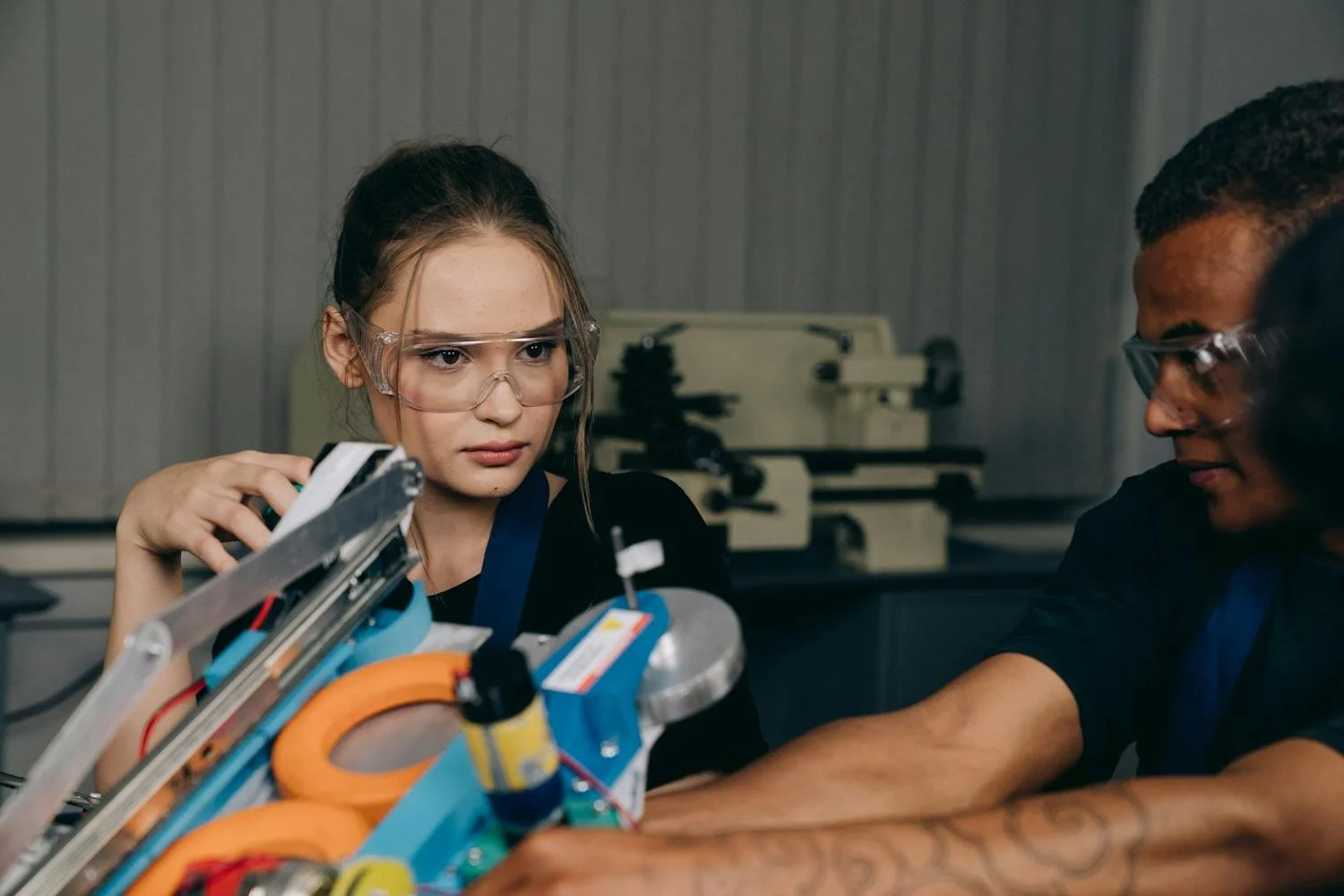
6. Role of STEM Tutoring in Practical Learning
Hands-on learning is not limited to schools — it thrives in personalized environments like STEM tutoring. Private tutoring sessions can simulate lab-style engagement, giving students space to explore concepts at their own pace.
A STEM tutor helps students:
Apply theoretical lessons through guided experiments
Strengthen connections between math, science, and technology
Build confidence in problem-solving through customized learning plans
At Stemly Tutoring, our approach blends structured instruction with creativity. We help students not only understand equations and theories but also apply them to real-world problems, from designing prototypes to analyzing data.
👉 Book a consultation to learn how our tutors can help your child thrive through hands-on STEM education.
7. FAQs
Q1: What is hands-on STEM learning?
Hands-on STEM learning involves experiential activities like experiments, projects, and problem-solving tasks that allow students to apply concepts in real-world contexts.
Q2: Why is hands-on learning more effective than lectures?
It engages multiple senses and encourages active participation, improving retention and understanding.
Q3: How can parents support hands-on learning at home?
Simple activities like building with LEGO, experimenting with household science kits, or coding games can develop hands-on STEM skills.
Q4: Can tutoring help with hands-on STEM learning?
Yes, a STEM tutor can personalize lessons and introduce hands-on projects that complement school curricula.
8. Next Steps
Hands-on learning transforms how students engage with STEM. It turns abstract equations into real-world solutions and sparks curiosity that drives lifelong learning.
To nurture creativity and confidence in STEM, prioritize experiential learning opportunities at school, home, or through personalized tutoring.
Book a consultation today to discover how Stemly Tutoring can bring hands-on STEM learning to life.